In my Principles of Microeconomics courses, I choose to start and end with consumer behavior.
At the start of our course, thinking about our thinking as consumers is a very relatable and accessible way for us to bring awareness to economic decision making. It helps highlight: tradeoffs, opportunity cost, and thinking at the next additional unit (at the margin).
So the first discussion assignment is a Meet & Greet Video that asks each student to share a bit about themselves and two products they buy for their morning routine.
Meet & Greet Video
Please introduce yourself with a Video!
Tell us:
Your name &/or what you would like us to call you
Something you would like to share with us about yourself like a hobby or what you like to do
A question you have about the economy
Two products that you buy for your morning routine and why you like them
Please keep your video to 1 minute or less
By the end of the semester, we have a lot more experience “thinking about our thinking” AND “thinking like an economist”. Also, thanks to exploring the market structure of Oligopoly, we have dived a bit deeper into Behavioral Economics (I will share my favorite activity for that module in a separate post). So wrapping up the semester with a module exploring Consumer Behavior helps us integrate, reflect, and review all the math and graphs (Oh, there’s that Production Possibility Frontier again in the form of a Budget Line!) and economic jargon (Oh, there’s another Marginal calculation applied to Utility this time!) we’ve learned along the way.
For our final discussion assignment, I ask my students to reflect on their own consumer behavior and whether or not it has changed as a result of our class. I use it as a way to help them integrate all that we have learned and share if they are choosing to apply it in their own lives. They also need to think back to their Meet & Greet videos and the two products they buy for their morning routine. But now they have to explain what market structure they think fits best for those products and their individual level of satisfaction (utility) for each product.
Students post their reflections in the discussion forum, but do not have to respond to their classmates’ posts on this one. They can choose to read their classmates reflections or not, but I hope they do!
Reflection: Will You Change Your Consumer Habits?
How has this class changed your perspective as a consumer?
Discuss at least one new thing you learned during this class. Has this class changed the way you think about your/our economy?
Will you change your consumer buying habits in any way? If so, how?
Think back to your Introduction video and the 2 products you said you use as part of your morning routine.
What market structure do you think fits best for each product?
Does advertising/brand name influence your decision to buy those products?
What level(s) of utility do you get from those products? What might change your level(s) of utility?
Sample Student Response
I catch myself weighing my options when I’m shopping all of the time. Now I realize what I’ve been doing all along is maximizing my utility while working within my budget constraint. This class has taught me that even the simplest decisions are actually much more complex, and economists have a very hard job to do.
I’ve always been pretty frugal so I think my habits will continue to stay that way. It’s interesting because looking for deals and being conscious of price changes has been my natural way of shopping but now I’m more aware of it and what it means.
The market structure for my first product, Estee Lauder moisturizer I think is monopolistic competition. Then Crest toothpaste I want to say oligopoly because I feel like there are a few big companies that have market power.
Somewhat, both are good brands. Most of my choices are based off of price. So, I will say when Estee Lauder advertises their deals I tend to buy more and stock up.
I get a high level of utility from my moisturizer because it works well for me, is from a trusted brand and stays relatively affordable. Toothpaste is toothpaste so I guess I get a moderate level of utility because it does the job. If either product stopped providing benefits, that would change my level of utility.
~KB, Student in Principles of Microeconomics Online (Fall 2025)
Ultimately, my goal is to help my students integrate what they have learned in our class and to continue to bring awareness to their thinking and behavior as a consumer (and producer) in our economy. I believe that the more we bring awareness to how our economy influences our choices AND how our choices influence our economy, the more our economy will reflect thoughtful and intentional choices. It is a small shift, hopefully in a positive direction.
My final class announcement after I posted grades this semester included a call back to Protective Patterns and how they influence our consumer behavior during holiday shopping…
End O’ Semester Announcement (F’25)
Final course grades are now posted. Thank you again for a wonderful semester!
Way to show up for yourself and your academic goals! I always find so much strength and hope as I see my students progress and succeed.
Before you go...
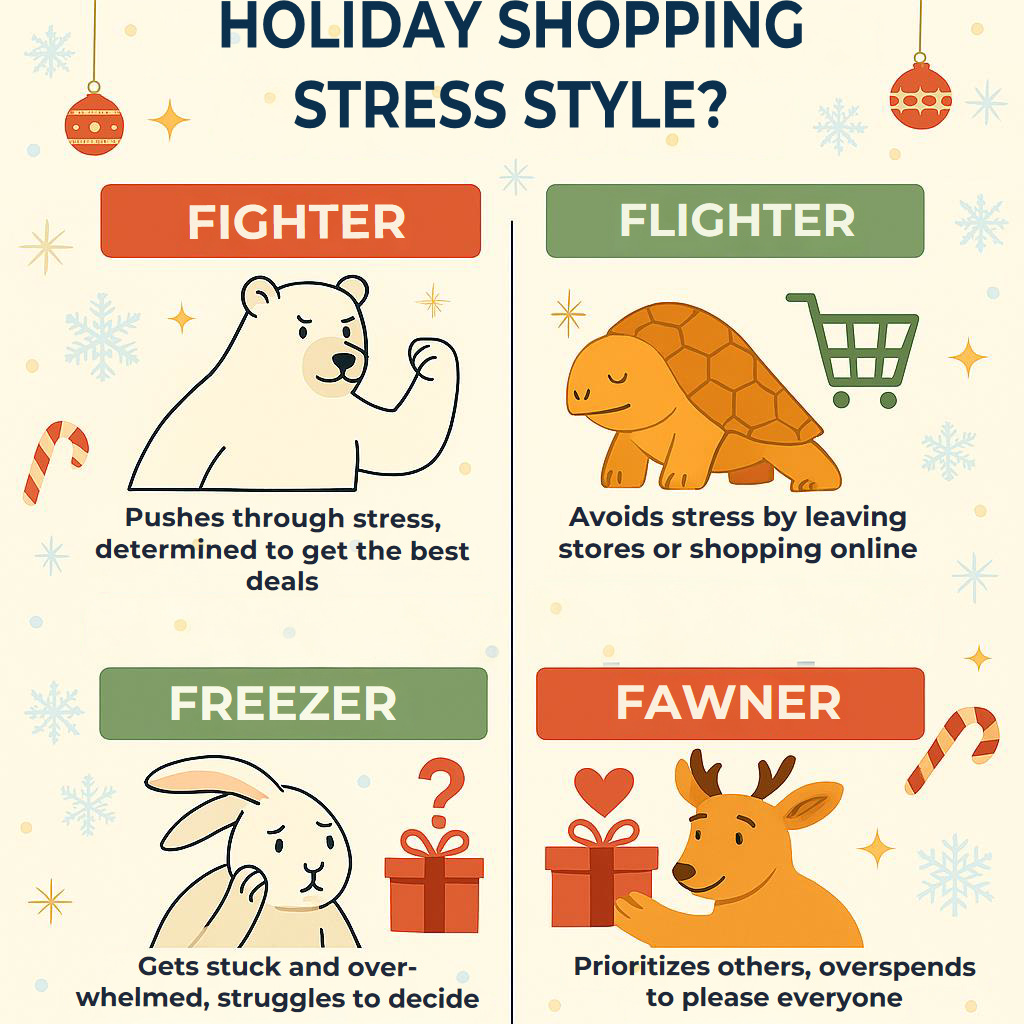
What’s Your Holiday Shopping Stress Style?
Holiday Shopping Stress Style Infographic
Fighter = Polar Bear — Pushes through stress, determined to get the best deals. Coping tip: Set boundaries and pace yourself.
Flighter = Turtle — Avoids stress by leaving stores or shopping online. Coping tip: Plan ahead and shop early.
Freezer = Snowy Hare — Gets stuck and overwhelmed, struggles to decide. Coping tip: Break tasks into small steps and start early.
Fawner = Deer — Prioritizes others over themselves, overspends to please everyone. Coping tip: Set a budget and remember your needs matter too.
***I’m a Freezer mostly, although I have moments during the holidays of a little of each of these styles. So for me, I’m always about breaking things down into small steps. One step at a time!***
As we have seen throughout this course, a bit of awareness of our consumer behavior can go a long way. And as we saw with supply and demand and many of the other graphs in this course, we do not always know the size of the shift, but we know the direction.
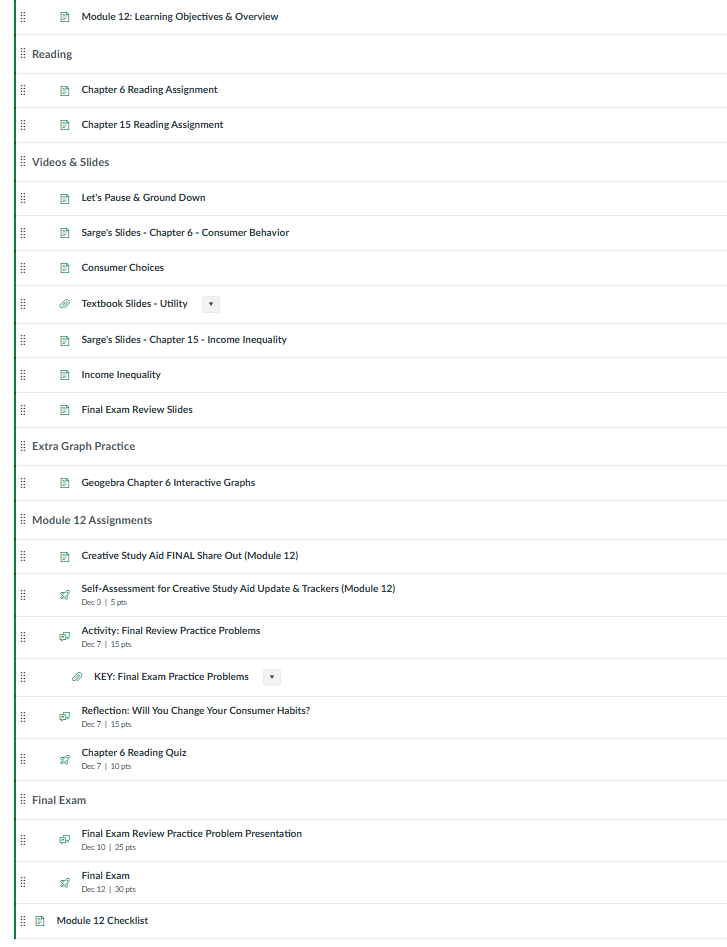
Screenshot of the Module
Screenshot of Module 12 for Principles of Microeconomics Online Course



Super interesting, Tiffany! Thanks for sharing!